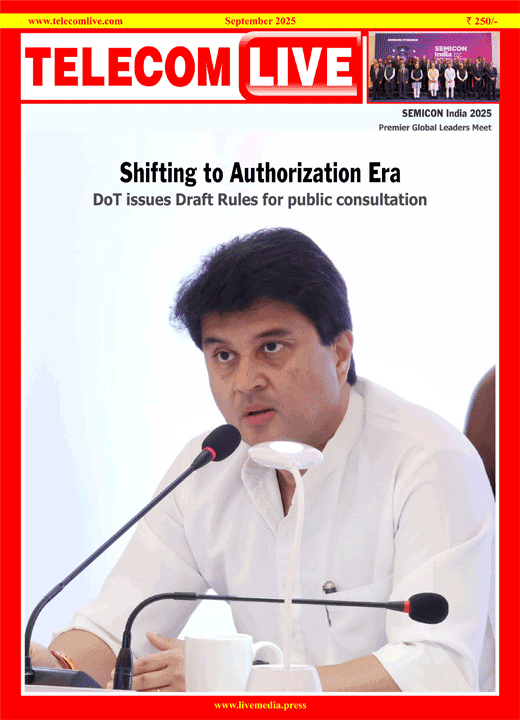
DoT has taken a major step towards modernizing India’s telecom regulatory regime by releasing two draft rules under the Telecommunications Act, 2023, for public consultation. It has issued the draft Telecommunications (Authorisation for Provision of Main Telecommunication Services) Rules, 2025, creating a uniform framework for granting authorization to companies offering core telecom services. Another draft Telecommunications (Authorisation for Provision of Miscellaneous Telecommunication Services) Rules, 2025, is designed to regulate non-core and auxiliary telecom services. Together, the drafts mark a shift to an authorization-based system aimed at ensuring consistency and clarity across the telecom ecosystem.
A clear categorization of services into four groups - main, miscellaneous, captive, and broadcasting has been introduced - ensuring each is regulated in line with its scope, consumer reach, and national importance. Authorizations will be granted to two types of entities: Network Service Operators (NSOs), which build or control telecom infrastructure, and Virtual Network Operators (VNOs), which deliver services by leasing capacity from NSOs. Both are eligible across all service categories, with mandatory transparency in agreements. The rules also require smooth customer migration if an authorization lapses, safeguarding continuity of services.
The draft rules divide the main telecom services into four sub-categories, each requiring separate authorization. The Unified Services Authorization is the most comprehensive, allowing operators to offer the full range of telecom services nationwide under a single license, covering both retail and wholesale markets.
The Access Services Authorization enables mobile and fixed-line operators to directly connect end-users within specific telecom circles, with obligations on interconnection, SIM distribution, KYC compliance, and separate spectrum assignments. The Internet Services Authorization applies to national and regional ISPs, permitting wired, wireless, and satellite-based connectivity, subject to strict cybersecurity, record-keeping, and lawful interception requirements. Finally, the Long-Distance Services Authorization covers national (NLD) and international (ILD) operators, who carry inter-state and global traffic respectively, with stringent conditions on lawful interception, monitoring, and secure international gateways.
The draft rules have carved out a dedicated category for Miscellaneous Telecommunication Services, recognizing the need for specialized authorizations outside mainstream telecom. This category has seven sub-licenses tailored to distinct service models.
Read the cover story for full details on categories, authorization specs, FDI restrictions, obligations of authorized entities and the impact of these for the telecom sector.