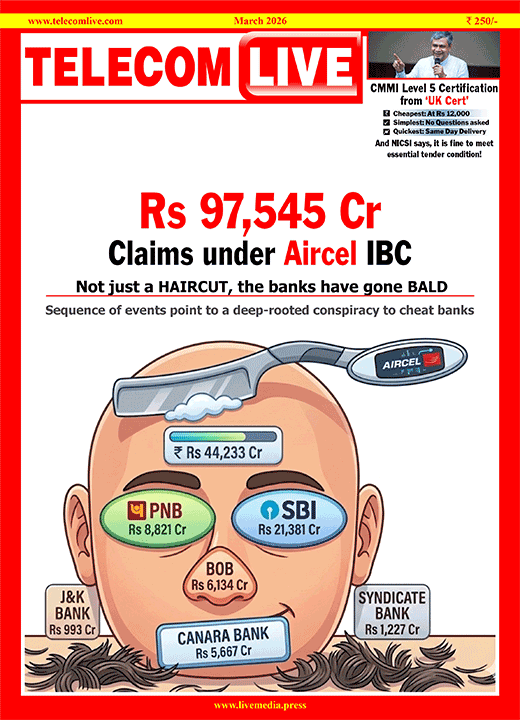
The Aircel IBC case, involving claims of Rs 97,545 crore, has led to total losses for banks - far beyond a typical “haircut,” effectively wiping out their entire exposure. The pattern of events suggests not just financial distress but potential systemic manipulation, raising concerns of a deep-rooted conspiracy to defraud lenders. Our cover story based on court filings, resolution plans, reports extensively through tables and charts of assets promised and imaginary, fund schedules, contexts, backgrounds etc.
Findings that stand out are many and serious. The insolvency resolution of Aircel has resulted in massive losses for lenders, with six major Indian banks collectively losing over Rs 44,223 crore of admitted claims after refinancing the group’s debt. The State Bank of India bore the largest loss, followed by Punjab National Bank, Bank of Baroda, Canara Bank, Syndicate Bank, and J&K Bank. Despite approval of the resolution plan by the Committee of Creditors and the NCLT which offered minuscule amount, banks are expected to recover virtually nothing.
The underlying collateral - licenses, spectrum, and telecom equipment - proved largely ineffective. Crucially, a February 2026 Supreme Court judgment upheld that spectrum couldn’t be transferred under the IBC without clearing dues, rendering licenses unusable and significantly eroding asset value. The remaining infrastructure has negligible residual worth. The successful bidder, UV Asset Reconstruction Company Ltd (UVARC), estimates total recovery at only Rs 150–210 crore, a fraction of the total exposure. Overall claims stood at Rs 97,545 crore, of which Rs 63,928 crore were admitted, but the entire amount has effectively been wiped out.
Aircel’s refinancing tactics for lender substitution and exposing lenders to higher downside risks through wishy-washy collaterals, delayed repayment schedule should have been red flags for the banks but they weren’t. The sequence of events raises serious concerns about systemic failures and possible collusion, highlighted by the absence of forensic audits, regulatory scrutiny, or investigative action by agencies such as the CBI or ED. The Aircel IBC case lays bare a shocking reality - how the bankruptcy process can be weaponized to systematically wipe out bank claims, leaving lenders staring at staggering losses.