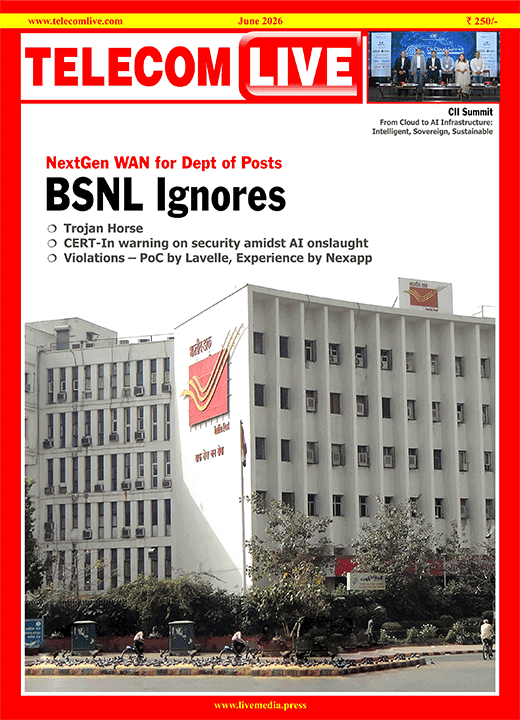
The Department of Posts (DoP)’s Rs 5,875 crore IT Modernization Project 2.0 is a big and important government technology contract. It is the digital backbone that will support India's postal, banking and insurance ecosystem for decades to come. That is precisely why the ongoing BSNL tender for the Next-Generation WAN deserves scrutiny.
At the heart of the matter are questions surrounding vendor eligibility. The tender explicitly prevents telecom service providers from participating, directly or indirectly, to avoid conflicts of interest. Yet as our cover story investigation shows, Lavelle Networks — an OEM for two competing bidders — is controlled by Bharti Airtel, a direct competitor in the digital payments and banking space. Bharti Airtel itself describes Lavelle as its subsidiary in its annual reports. It is not an issue of technical interpretation; the relationship is clearly stated through Compulsorily Convertible Preference Shares (CCPS) investments, increasing commercial dependence of Lavelle on the Bharti Group and statements in annual reports. These are evidences of effective control. Any legal opinion obtained without placing these facts on record inevitably raises questions about compromised due diligence and the role of officials involved in it.
BSNL’s handling of the Proof-of-Concept (PoC) evaluation is also alarming. Lavelle demonstrated mandatory security capabilities using Fortinet equipment, although those products were neither part of the original bid nor compliant with the tender’s Make-in-India requirements.
Similarly, Nexapp, quoted by another bidder failed to satisfy the tender’s experience requirement despite submitting records indicating deployment of over 45,000 SD-WAN devices. These deployments did not utilize the required SD-WAN functionality, the equipment performed unsatisfactorily in the referenced project. BSNL did not verify these claims and qualified the bid.
Then there is a total abandoning of cybersecurity responsibilities despite repeated warnings by CERT-In of AI-powered cyber threats becoming cheaper, faster and more sophisticated. It is difficult to understand why a project of such strategic importance would settle for anything less than the highest security standards.
Given that India Post operates extensive banking, insurance, and postal services with millions of customers and substantial financial assets, any conflict of interest, security weakness, or deviation from tender conditions could jeopardize the objectives of DoP’s IT Modernization. In a project of this scale, the cost of overlooking warning signs could far exceed the value of the contract itself.